 Careers
Eliminating a Crude Heater Bottleneck and Unlocking 4% Additional Throughput
Plant And Operational Context
A major European refinery had been operating with a long-standing throughput limitation linked to one of its crude heaters. As a critical asset in the crude distillation unit, the heater directly supports refinery capacity, energy efficiency, and operational flexibility.
Over time, declining heater performance had become a constraint on production targets. Severe fouling within the convection section reduced heat recovery, while inefficiencies within the radiant section further limited overall thermal performance.
Together, these factors created a bottleneck that restricted throughput during high-demand seasons and prompted consideration of a major heater upgrade.
The objective was to restore heater performance and recover lost capacity without committing to a large capital project or extending turnaround duration.
U24-26474

Evaluating A More Efficient Path Forward
Several options were considered to address the throughput limitation, including a full heater revamp and targeted mechanical modifications.
Rather than pursuing a high-capex upgrade, the refinery selected a combined Tube Tech Rovex™ robotic convection cleaning and Cetek® high emissivity refractory coating solution that could be executed during a planned turnaround.
The decision was supported by a detailed thermal performance assessment conducted by IGS. The study identified the primary causes of the performance shortfall and quantified the expected operational benefits of addressing both convection section fouling and radiant section heat transfer efficiency.
The refinery had previously engaged IGS on multiple successful projects across the site, including furnaces, Texas towers, and convection section applications, providing additional confidence in the proposed approach.
Identify The Sources Of Performance Loss
A detailed engineering assessment identified severe fouling throughout the convection section as the primary cause of the heater’s performance decline. Refractory debris, corrosion products, and hardened deposits trapped between serrated finned tubes were restricting heat recovery and gas flow across multiple convection banks.
Infrared thermography confirmed that the radiant tubes remained relatively clean, allowing the turnaround scope to focus on robotic convection cleaning and high emissivity refractory coatings to address the specific mechanisms limiting performance.
This targeted intervention maximized the operational benefit of the planned outage.

Delivering The Required Outcome During A Six-Day Turnaround
IGS executed the complete scope within six days, addressing performance limitations in both the convection and radiant sections within the planned outage window.

TubeTech Rovex™ Robotic Convection Cleaning
All four convection banks were cleaned using TubeTech’s patented no-man-entry Rovex robotic cleaning technology.
Heavy deposits, including refractory debris, corrosion products, metallic fragments, and hardened fouling (Figures 1 & 2), were removed from the tube bundles and finned surfaces. The cleaning process restored more than 90% of the available heat transfer surface area, improving heat recovery from flue gases and reducing thermal resistance throughout the convection section (Figures 3 & 4).
The robotic approach (Figure 5) eliminated the need for personnel entry into confined spaces while enabling rapid and effective cleaning of heavily fouled tube banks.
Convert Thermal Efficiency Improvements Into Additional Refinery Capacity
Post-project evaluation confirmed that the measured performance improvements closely matched the benefits predicted during the engineering study.
The results demonstrated meaningful gains in fuel efficiency, emissions performance, operating flexibility, and throughput potential.
Cetek® High Emissivity Refractory Coatings
Following the engineering assessment, Cetek® high emissivity refractory coatings were applied to the radiant section floor, walls, and roof (Figures 6 & 7).
The coating system increases the emissivity of refractory surfaces, allowing a greater proportion of radiant heat to be transferred to the process. This improves thermal efficiency, lowers furnace operating temperatures, and supports reduced fuel consumption and emissions.
Together, the two technologies addressed the key contributors to lost heater performance and throughput restriction.

Verified Performance Improvements
| Performance Metric | Before | After (Normalized) | Improvement |
|---|---|---|---|
| Total Fuel Efficiency | 75.4% | 77.2% | 1.8 p.p. (2.3%) |
| Fuel Firing Demand | 47.13 Gcal/hr (187 MMBtu/hr) | 41.98 Gcal/hr (167 MMBtu/hr) | Reduced fuel consumption |
| Relative Fuel Savings | – | 1.1 Gcal/hr (4.4 MMBtu/hr) | 2.3% reduction |
| Stack Temperature | 325°C (617°F) | 311°C (592°F) | 14°C (25°F) reduction |
| Bridgewall Temperature | 777°C (1,431°F) | 754°C (1,389°F) | 23°C (42°F) reduction |
| Annual CO₂ Emission Reduction | – | 2,060 TPA | Lower emissions |
| Estimated Annual Savings* | – | $644,000 USD | Reduced operating costs |
| Additional Throughput Potential w/o Hitting BWT Limitations During High-Demand Season | – | Up to 4% | Increased refinery capacity |
* Based on a fuel cost of approximately US$46/Gcal and a CO₂ cost of approximately US$104/tonne.
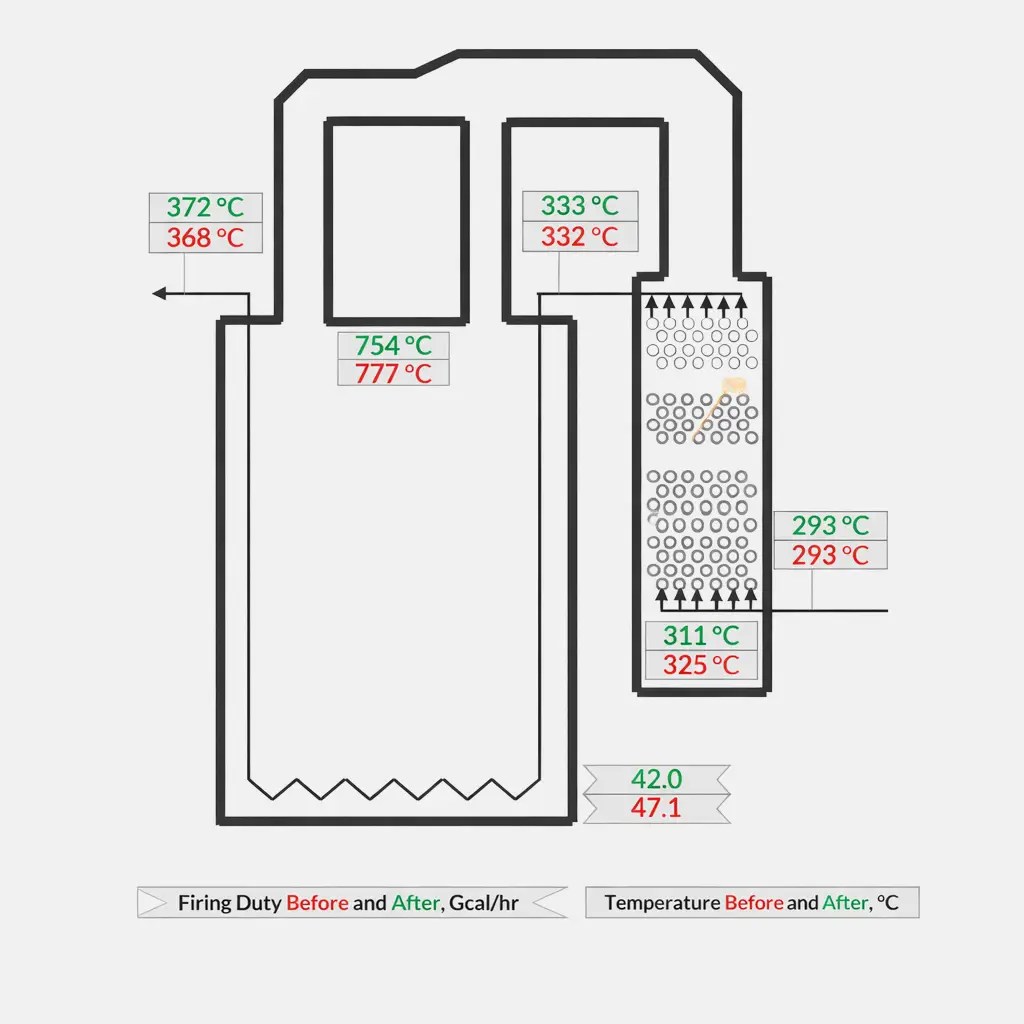
The reduction in stack temperature indicated improved heat recovery in the convection section, while the lower bridgewall temperature confirmed improved radiant heat transfer efficiency (Figure 8).
Most importantly, the refinery regained operating flexibility. At the original bridgewall temperature limit, the crude heater now has the potential to support up to 4% additional throughput during periods of increased demand, removing a bottleneck that had constrained production for years.
These gains were achieved without a major heater revamp, allowing the refinery to improve performance, reduce operating costs, lower emissions, and create additional capacity through a targeted six-day turnaround scope.
The strong correlation between predicted and measured results also validated the engineering approach used to identify and address the throughput constraint.
Figure 8 – Results Before and After Combined Solution
A six-day turnaround removed a long-standing bottleneck, unlocking up to 4% additional
throughput.
That’s Asset Vitality.
Enable Future Production Growth Without Additional Capital Investment
By removing a long-standing crude heater bottleneck, the refinery has created additional operating flexibility to be used during high-demand periods without exceeding existing heater operating limits.
The project demonstrated how targeted thermal performance improvements can unlock latent capacity within existing assets while simultaneously reducing fuel consumption and emissions.
The successful outcome also reinforced confidence in engineering-led optimization projects as an alternative to larger capital-intensive upgrade programs.

“The refinery’s objective was to recover lost throughput without committing to a major heater rebuild. By combining robotic convection cleaning with high emissivity refractory coatings, we improved thermal efficiency, reduced fuel consumption, and increased throughput during a planned turnaround. The post-project results confirmed the value of that approach and demonstrated how targeted engineering improvements can deliver meaningful operational benefits.
The Refinery Turnaround Team provided comprehensive support to IGS throughout all phases of the project, ensuring effective coordination, timely execution, and alignment with operational objectives. Their expertise and collaboration were instrumental in successfully delivering key turnaround activities while maintaining high standards of safety and quality.”
– Michael Nygaard, Director, IGS Scandinavia
WATCH: IGS’s Cetek Ceramic Coating Technology
Free consultation with an IGS Subject Matter Expert
IGS is here to provide information, answer questions and create an effective solution for your needs.